
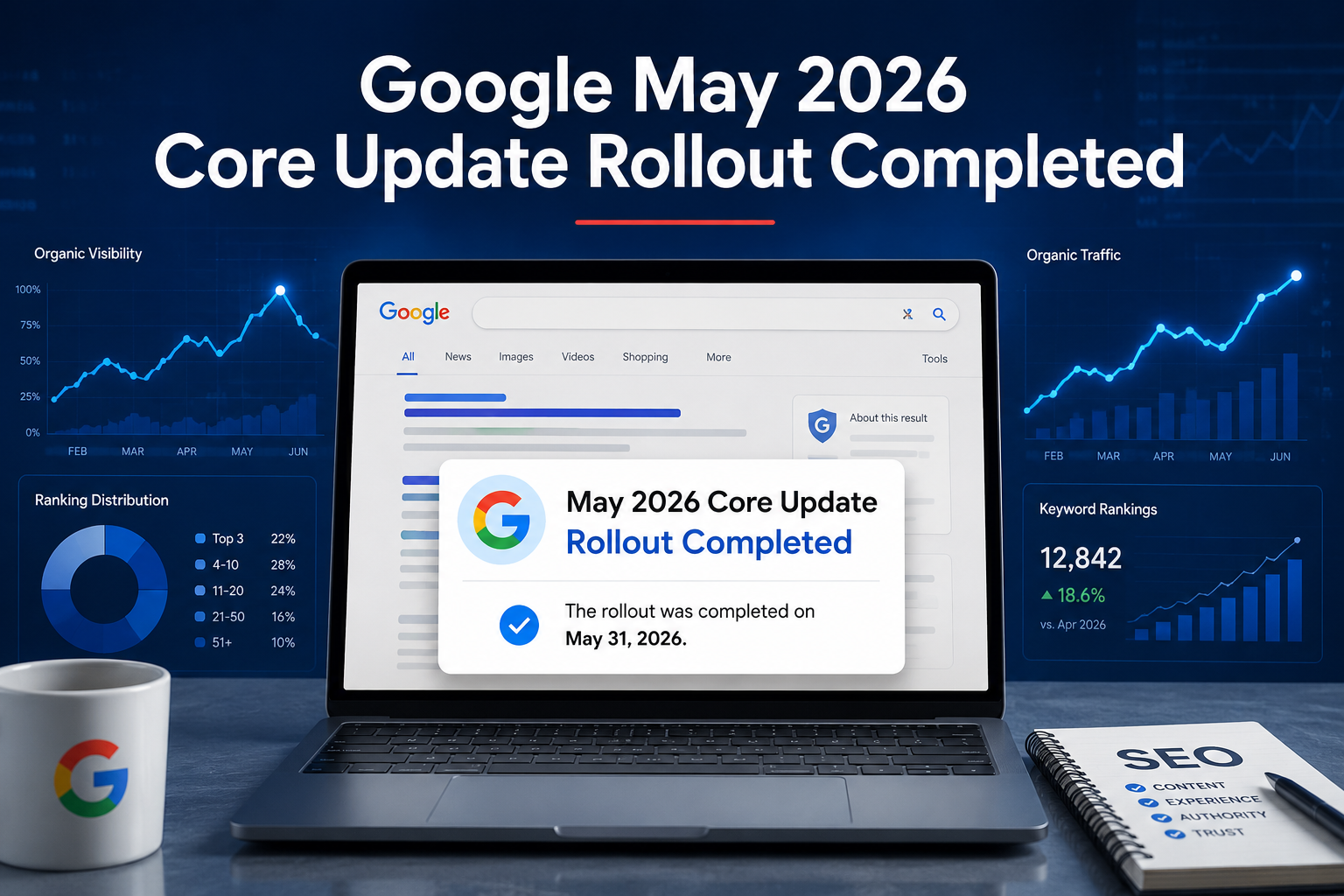
Google has officially completed the rollout of its May 2026 Broad Core Update, ending a 12-day deployment that began on May 21, 2026. The update finished rolling out on June 2, and many website owners, publishers, and SEO professionals reported noticeable ranking fluctuations throughout the process.
According to Google, this was a standard core update designed to improve how Search surfaces relevant and satisfying content for users across all types of websites.
Key Facts About the May 2026 Core Update
- Launch Date: May 21, 2026
- Completion Date: June 2, 2026
- Rollout Duration: 12 days
- Impact: Global, affecting all languages and regions
- Scope: All content types and industries
- Purpose: Improve Google’s ability to surface helpful and relevant content
Unlike manual penalties, core updates are designed to reassess content quality and relevance across the web. Sites that gain visibility are not necessarily “rewarded,” while those that lose rankings are not automatically being penalized.
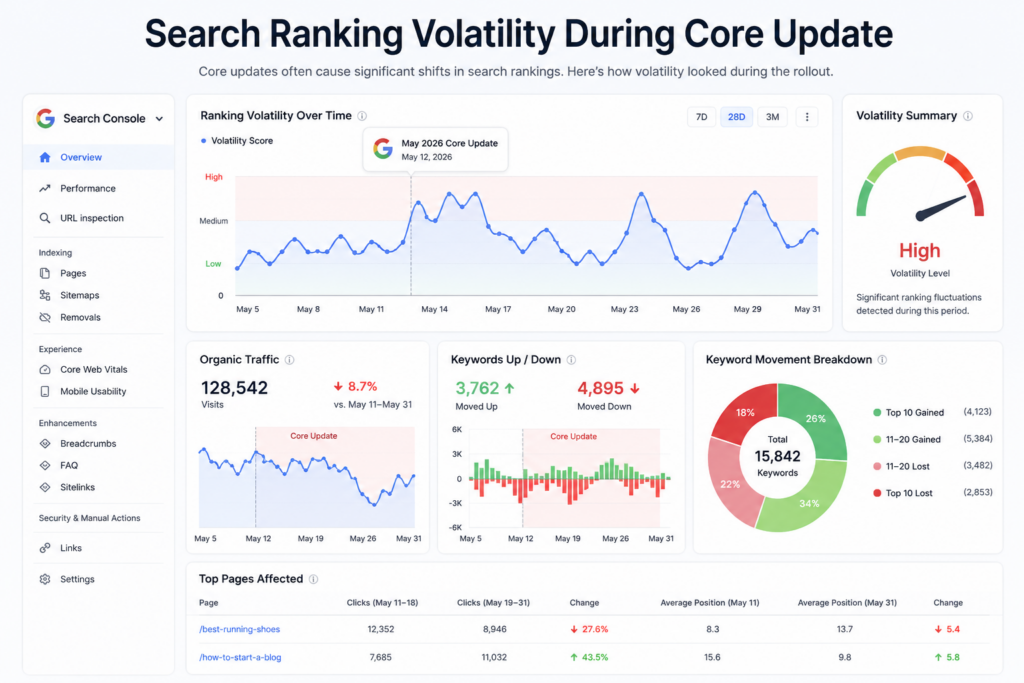
Significant Ranking Volatility Observed
Throughout the rollout, SEO tracking tools and industry observers recorded several waves of ranking volatility. Major fluctuations were reported shortly after the update launched, followed by additional spikes during the final days of the rollout.
Many websites experienced:
- Sharp ranking increases or decreases
- Traffic fluctuations across key pages
- Changes in featured snippets and search visibility
- Discover traffic shifts
- Movement across competitive search results
As with previous core updates, some industries saw stronger effects than others.
What Should Site Owners Do Now?
Now that the rollout is complete, website owners can begin evaluating the full impact on their organic performance.
Focus on:
1. Analyze Winners and Losers
Review:
- Organic traffic trends
- Keyword ranking changes
- Landing page performance
- Search Console visibility data
Look for patterns rather than isolated ranking drops.
2. Improve Content Quality
Google continues to prioritize content that demonstrates:
- First-hand expertise
- Original insights
- Strong topical authority
- User-focused value
- Trustworthiness and accuracy
Thin, repetitive, or purely search-engine-driven content is becoming increasingly difficult to rank consistently.
3. Strengthen E-E-A-T Signals
Ensure your content clearly demonstrates:
- Experience
- Expertise
- Authoritativeness
- Trustworthiness
This includes author profiles, citations, transparent sourcing, and evidence of real-world experience.
4. Focus on Search Intent
Many ranking changes after core updates occur because Google has improved its understanding of user intent.
Review whether your pages truly satisfy what users are looking for when they perform a search.

How Does This Compare to Previous Core Updates?
The May 2026 Core Update appears to have generated more visible ranking turbulence than the March 2026 Core Update. While Google described it as a regular core update, many SEO professionals reported significant movement across a wide range of industries.
As Google continues integrating AI-powered search experiences and evolving ranking systems, core updates are increasingly focused on rewarding content that provides genuine value rather than content created primarily for rankings.
Final Thoughts
With the May 2026 Core Update now complete, the next few weeks will be critical for assessing long-term winners and losers. Avoid making reactive changes based on short-term fluctuations. Instead, focus on creating genuinely useful content, improving user experience, and building topical authority.
Sites that consistently help users solve problems, answer questions, and provide unique insights remain best positioned for long-term search visibility, regardless of future algorithm updates.