
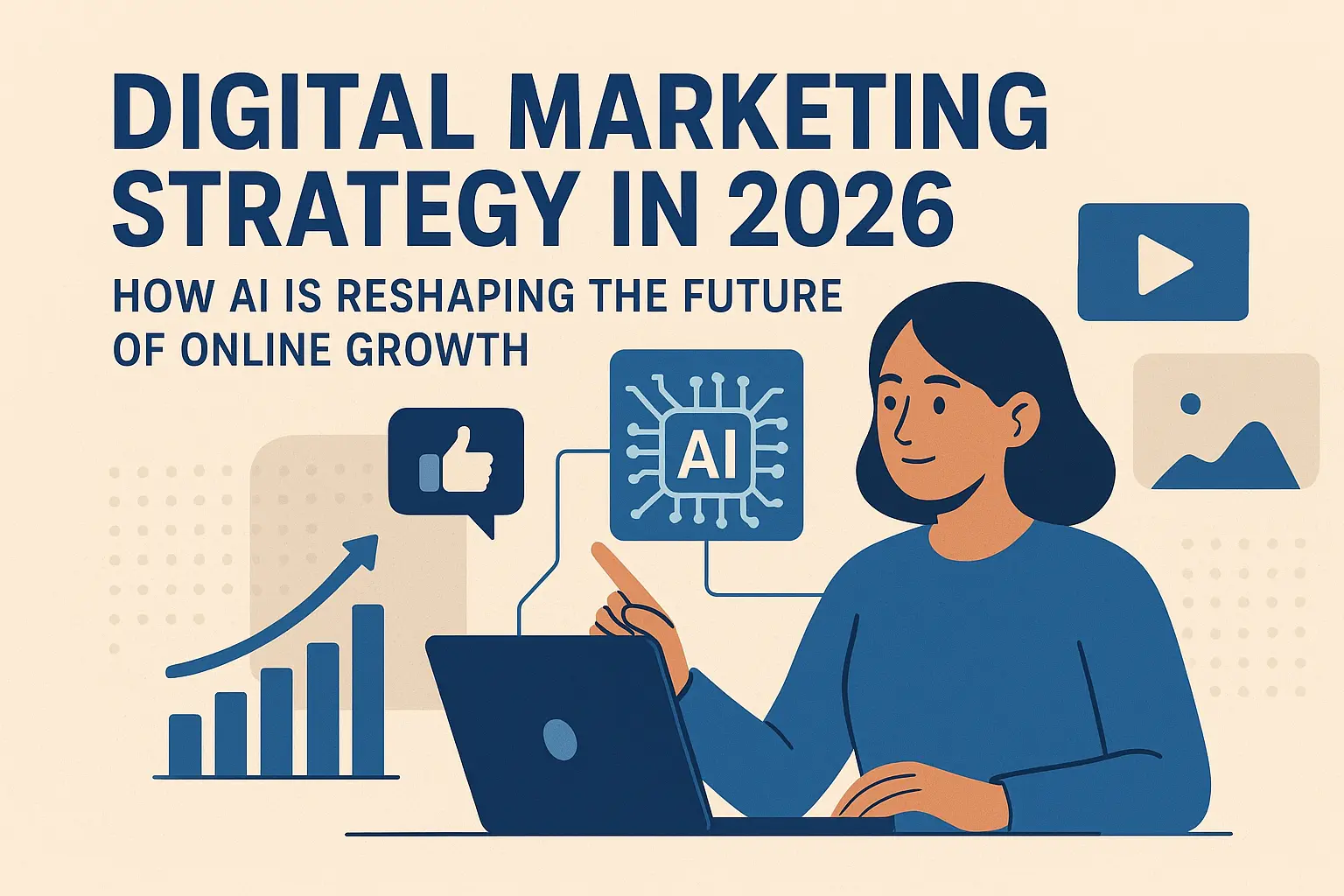
Remember the days when “personalization” just meant dropping a customer’s first name into an email subject line? It feels like a lifetime ago, doesn’t it? The truth is, the world of online growth has always been a fast-moving target, but in 2026, the speed of change feels like we’ve gone from a bicycle to a supersonic jet and Artificial Intelligence (AI) is the new engine.
For any business looking to thrive, a robust digital marketing strategy is no longer a luxury; it’s the absolute core of survival. Today, that strategy must be fundamentally built around AI. It’s not about replacing humans; it’s about amplifying human intelligence and creativity with machine precision. Let’s dive into how AI is making old playbooks obsolete and carving out new paths for success.
1. The Death of Generic Content: Hyper-Personalization is the New Baseline
In the past, marketers segmented audiences into large, general buckets. Now, AI allows for a staggering level of personalization, what we call hyper-personalization.
Imagine your website automatically changing its layout, headline, and even the featured products the instant a visitor lands on it, based on their real-time browsing history, location, and predicted intent. That’s the power AI brings. It analyzes millions of data points from where a user hesitated on a page to their last social media interaction and creates a truly unique experience.
For a forward-thinking website design company, this means the very structure of a site must be built to be dynamic, not static. It’s no longer about a beautiful single design; it’s about a thousand intelligent, adapting designs, all powered by AI. This kind of nuanced, one-to-one communication is what earns customer trust and drives conversions.
2. From Guesswork to Foresight: The Rise of Predictive Analytics
One of the most revolutionary impacts of AI is its ability to forecast the future of consumer behavior. We’re moving away from simply reporting on what happened last month to accurately predicting what a customer is most likely to do tomorrow.
- Predictive Lead Scoring: AI models can now score leads with incredible accuracy, telling a sales team exactly which prospects are most likely to convert in the next 72 hours. This ensures that marketing spend is focused only on the highest-intent audiences, drastically improving the ROI of your digital marketing strategy.
- Trend Forecasting: Before a trend even surfaces on social media, AI can spot the emerging signals in search queries, forum discussions, and market data. This allows brands to be at the forefront of a conversation, rather than just reacting to it.
A specialized digital marketing agency in 2026 uses this predictive power not just for ads but to inform the entire content pipeline, ensuring every blog post, email, and video is aligned with the customer’s future need.
3. The Automation Revolution: Content at Scale
Content remains king, but the speed and volume required to compete have become unsustainable without assistance. Generative AI tools are now integral, automating the repetitive parts of content creation:
- SEO-Optimized Drafts: AI can generate first drafts of blog posts and long-form articles that are already optimized for conversational and traditional search, handling the initial keyword clustering and structural elements.
- Dynamic Ad Creatives: AI can produce hundreds of variations of ad copy and imagery in minutes, testing them in real-time to find the optimal combination that resonates with different audience segments, maximizing the effectiveness of your digital marketing strategy.
This efficiency doesn’t remove the human touch; it liberates it. Marketers are moving from tactical execution to strategic oversight and creative refinement, ensuring the final output maintains a unique, authentic brand voice.
4. Why the Human Element is More Critical Than Ever
While AI handles the data analysis and execution, the true competitive advantage in 2026 lies in the human capacity for strategy, ethics, and creativity.
A great digital marketing strategy isn’t just about using AI tools; it’s about knowing how to prompt them, how to refine their output, and how to build campaigns that resonate on an emotional level, something machines still struggle with.
This is where a dedicated partner comes in. Companies like Sharptech Company are not just adopting AI; they are masterfully integrating it into their human-led creative workflows. They understand that AI is a co-pilot, not an autopilot. Their expertise in blending cutting-edge tools with a deep understanding of human psychology and brand storytelling is what allows them to craft a truly next-generation digital marketing strategy for their clients.
Embracing the AI-Driven Future
The digital marketing landscape has reached a pivotal point. Ignoring the seismic shift caused by AI is simply not an option. For businesses, the time to adapt is now. Whether it’s partnering with an expert digital marketing agency to redesign your funnel or working with a cutting-edge website design company to build an AI-adaptive platform, your next move will define your growth trajectory for the rest of the decade. The ultimate takeaway for your digital marketing strategy in 2026 is simple: use AI to work smarter, not just faster. Automate the predictable so you can focus on the exceptional.